Showing posts with label Gibson. Show all posts

Thursday, November 20, 2014

Even though it's a guitar shop....

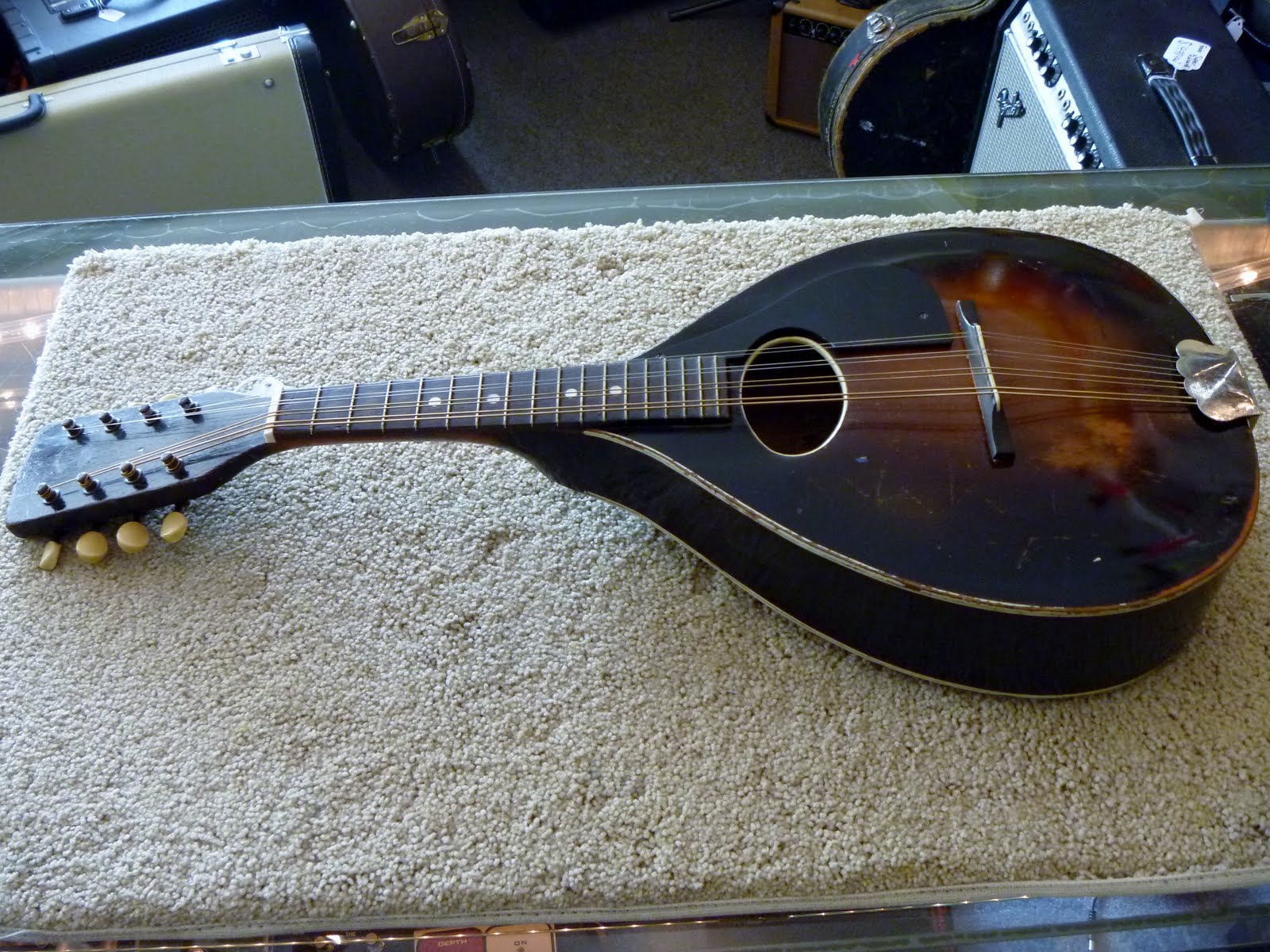
I do occasionally buy non-guitar stuff.  Rarely, but every once in a while I will buy something just because it's prewar or uncommon.  This one is from the mandolin family.  It is branded Wurlitzer.  Yes, the jukebox company.  Over the years Wurlitzer has offered many products including pianos, organs, and guitars.  If anyone has an old Wurlitzer acoustic, I'm a buyer.   
This mandolin is for sale - $399


Saturday, August 6, 2011

Gibson US-1


Lately we've been on a 1950's nostalgia trip - a time of poodle skirts and hairdos slicked down with pomade.  Today, just for a change of pace, let's visit the 80's - time of poodle-like hairdos held together with plenty of aquanet.  Back then, the "Superstrat" was the very latest craze, a tricked-out amalgam of traditional Fender-style curves and shred-geek gizmos that upstart companies like Kramer and Charvel made their name on.  Even Gibson got in on the act, as you can see by this 1988 US-1. 


As you can see, this guitar has the single-single-humbucker configuration that defined a "Superstrat," along with the near-ubiquitous Floyd-style tremolo.  The pickups have individual on-off toggles instead of a three-way switch, and the finish and binding straddle the line between the guady neon era and something a little classier.  What you don't see is the "Chromyte" that Gibson used as a lightweight filler in the chambered body.  You and I would know it by a different name - balsa wood!  Odd as it sounds, it actually works pretty well, adding some air to the bright, spiky-sounding pickups.


Design-wise, the headstock was obviously borrowed from the Explorer, with the Grover tuners and locking nut checking off the last boxes on the shredder checklist.  Even though Gibson has long since passed through it's midlife crisis and now mainly sticks to the classic designs of old, this axe serves as a neat relic of it's day and a great deal for anyone looking for an American-made Gibson that you can do dive-bombs on.

Thursday, August 4, 2011

Gibson Trini Lopez


Here's another one that a friend brought in to show off.  Yes, the same guy that had the Supro amp, the lap steel, and the National Belaire.  Some people have all the fun.  This is a Gibson Trini Lopez from the mid-sixties,  a semi-hollowbody with a distinct look that sets it apart from its closest cousin, the ES-335.  Trini Lopez sang mostly pop and strummed with a bright, infectious feel, but the eye-catching diamond soundholes and inlays of his signature guitar have given it a cult following amongst well-off rockers like Dave Grohl and Noel Gallagher.


The owner swapped out the original pickups for these high-output coil-tappable beasts sometime in the 80s, though he swears he's got the original pickups squirreled away somewhere.  These pickups have have a good tone, though they do look a little conspicuous next to that yellowed binding and checked, aging finish!  Also - that amp in the back is one of ours; a nice little small-wattage Gibson Skylark with built-in tremolo.


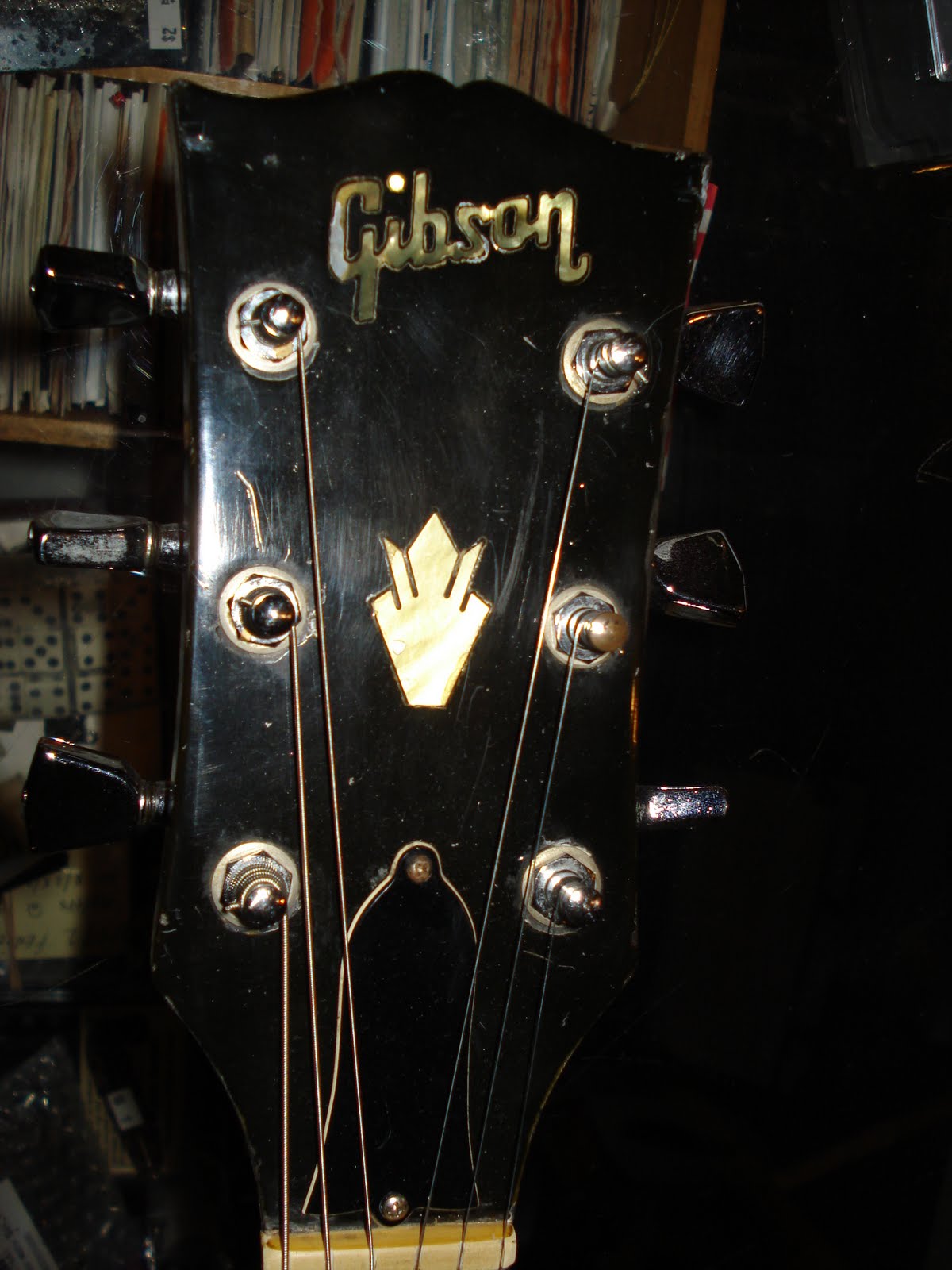
As you can see, the headstock is similar to the ones used on the Firebird models.  I don't know how well you can see from this picture, but a "friend" of the owner's apparently took it upon himself to drill extra holes in the headstock, to change the tuners to a "3x3" arrangement.  The holes have been filled in since then, but yeesh, with friends like these... Still, this is a fantastic old Gibson; a little piece of history that you can still play!

Saturday, July 30, 2011

Gibson ES-330T


More vintage finds - the guitar is a 1960 Gibson 330T, and the amps are a Gibson GA-18 Explorer and a Premier 120, both from around the same era.  Both amps sport a funky, darker tone that would have been an alternative to the bright, spikey twang of the new-fangled Fender amps of the day.  On-board reverbs were an unknown quantity at the time these amps were built, so a swampy and moody tremolo is the only effect available on either.


The ES-330T is basically a one-pickup version of the more famous ES-335, and this one has aged beautifully, with a some nicely yellowed binding and some fine, subtle checking on the finish.  The 'burst   Like the similar one-pickup ES-125, this stripped-down model is a great value for a vintage Gibson!  Who needs two pickups, anyway?

Sunday, July 17, 2011

Gibson ES-125 and BR-9 Amp


Here's a pair right out of the 1950s - a Gibson ES-125 and a BR-9 amplifier. We've had another ES-125 in the store before, but like we say, you can never have too many guitars from the 50s. Playing through this rig makes me want to play some jazzy jump blues licks, or maybe some western swing.  Much like those bygone musical styles, this guitar and amp have authentic roadhouse appeal, but also a certain sweetness and delicacy that often goes unappreciated.


The body has been re-finished somewhere along the line, but it's in an attractive cherry burst, very professionally done.  That lone pick-up is all original, though.  Sure, it's only one pickup, but if you can only have one pickup, an old Gibson P-90 is a damn good one to be stuck with.  ES-125s have a reputation as the "best deal" in vintage guitars because the basic design and single pick-up layout have kept the prices well below the likes of an ES-335, ES-175, etc.


The BR-9 was built between the late forties and fifties.  It has a single 8-inch speaker and a very distinctive tonal identity: whereas most of our small low-wattage tube combos very quickly break up into snarling distortion, the BR-9 stays clean and crisp even with the single volume knob wide open.  The most you'll get out of this one is a little extra warmth, a little "blurring" around the edges.  Early amps like this were designed with "hi-fidelity" in mind, so conspicuous crunch and grind tones were to be avoided.


The control panel is about as simple as you can get!  No tweaking necessary.  I also believe these amps were also meant to be played with a lap steel guitar.  This amp would certainly be a boon to any tone connoisseur and/or studio rat.  I can't think of any piece of gear that so effortlessly conjures up the sound of early honky-tonk, Hank Williams, and big Cadillac cars with new whitewall tires.

Tuesday, May 31, 2011

Planet X


Here's something different - one of our regulars, Dennis Redd playing his composition "Planet X."  Here Dennis is picking on "Bessie," our repair tech Donnie's 1964 ES-335, and playing through a Univox tape echo into a Peavey Classic 50.

Thursday, May 26, 2011

Mando-rama


A guy came in a few weeks ago to show off a couple of really cool mandolins.  This one is made by Beltona, a New Zealand-based company that specializes in resonator instruments built with non-traditional body materials - carbon fibre, resin, etc.  The combination of a metal cone and non-wood body makes for some extremely loud acoustic instruments, though the tone is never harsh or shill. 


They also make some very cool guitars and ukuleles, but the Koru mandolin is maybe their snazziest looking in terms of design.  Very high-quality stuff; you can check out their website and hear audio samples, though the most amazing thing is, again, the remarkable projection and power - this little guy had as almost as much volume as a small tube amp!


Here's another stunning mandolin - a Gibson A-style from gee, maybe the 1910s?   Very good condition, too, considering it's age.  Sometimes pictures speak louder than words, so I'll just let everybody soak up the gorgeous detail pics of the top, inlays, etc...


There you go.  In a few more years, Gibson would reach a peak with the F-5 mandolins of the 20s, probably the mandolin pickers' equivalent of a '59 Les Paul.  Still, even the more modest A-styles have a simple elegance that you'd be hard-pressed to beat.


And, finally, here's the shop's very own vintage mandolin.  It was sold to us as an old Kay, although somebody last week suggested that the flame back was more indicative of a Harmony from the 50s.  It's obviously showing more wear than that old Gibson, but when you rake a pick across the strings this thing jumps to life with a bright and still-vibrant tone and very smooth playability.


So there you go - a trio of mandolins, from the mighty Gibson down to our humble "no name" A-style.  Of course, you can pick this one up and take it home with you for far less than you'd pay for a Gibson!


Wednesday, May 18, 2011

Gibson SG Jr and Tweed Fender Champ


A few people were in today just sharing - here's a 1964 Gibson SG Jr.  The guy said it was given to him by his grandfather.  It has some age on it - if you tilt the neck just so you can see a little greenish patina along the frets.  Still, it played pretty good, with a nice, comfortably worn neck.


Sadly, though, the Bigsby vibrato had been dismantled somewhere along the line.  I guess most players just don't dig a vibrato on an SG, though I've personally always thought an SG and a Bigsby go together like peaches and cream.  That single P-90 still sounds fat and sweet, though.   


Here's a 1954 Fender Champ!  Behold the mighty, mighty tweed.  A little roughed up, but miraculously intact.


 Just think, when this amp was being built, Elvis was just a poor cracker truck driver trying to break into recording and performing, Johnny Cash was an appliance salesman in Memphis, and hell, Chuck Berry had only been to prison once!

Saturday, April 2, 2011

1983 Gibson Challenger


Here we have one of Gibson's early 80s experiments, the Challenger.  From a distance, it looks to be yet another Les Paul, but the Challenger has a very un-Gibson-like bolt-on maple/rosewood neck, not to mention an extremely 80s retro-futuristic "Robot Gray" finish.


The amp here is a Gregory Bass 60A, a low watt mini-stack from what was allegedly a rather small New Jersey-based company in the 50s and 60s.  There is what looks to be an exhaustive look at the Gregory line here, although all you really need to know about this one is that it sounds awesome and looks spiffy, once again proving my theory that the best guitar amps are all really failed attempts at making a decent bass amp.


Back to the Challenger - it's hard to see with the black pickguard/black pickup configuration, but the original humbucker has been replaced with a very fine and pricey Bartolini.  The clean sounds are amazing, and even with gobs of distortion piled on, the pickup retains its punchy character. The little switch seems to act as a coil tap, which gives you a few more tonal options to play with on this single-pickup guitar.  Overall, you could do much, much worse from the era of spanex, leg warmers, and neon.

Saturday, March 26, 2011

Gibson Custom Shop ES-339


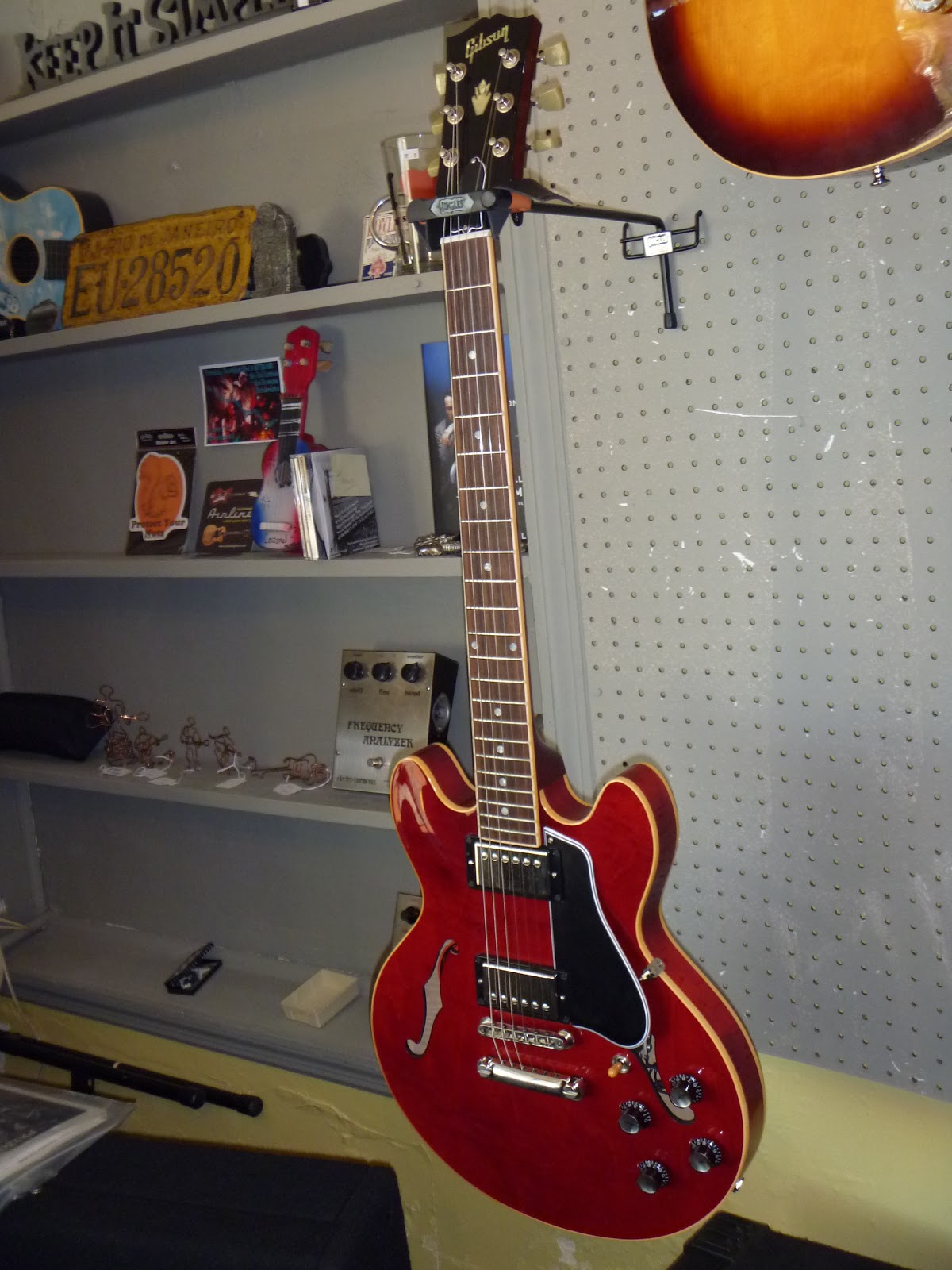
Here's a gorgeous red Gibson Custom Shop ES-339 that we've recently acquired.  The spiel on the 339 is that it has a smaller body about the size of a Les Paul, but is semi-hollow with a center block just like its older sibling, the ES-335.  For anybody that finds themselves overwhelmed by a regular semi-hollowbody, this guitar is a dream come true.

Gee, you got a purty finish
The 339 comes with '57 Classic humbuckers, and can pump out all the thick, singing lead tones of the 335. Gibson also touts the "Memphis Tone Circuit," which is supposed to let you work the guitar's volume knob without losing any of that sweetness in the treble frequencies.  All in all, a versatile instrument with super-classy looks.

Friday, March 18, 2011

Les Paul Studio - and friends


Here's a early 90s Les Paul Studio, sitting next to a Silvertone 1472 and a Danelectro DS-50.  This is the key to great sludge rock tone, folks.  Just punish these cranky old amps with a modern high-output pickup and enjoy the carnage.  The Silvertone gets particularly scary when cranked.  The Danelectro has cool retro-futuristic styling, and the same "piggyback" design as the Silvertone Twin Twelve - the head just slides into the back of the cabinet.  Sweet.

Sunday, March 13, 2011

Bizarro World


Good lord - it's a window into a parallel universe!!  It's a strange and twisted place, where banjos have six strings, guitars have only four, and bass players get all the groupies.  Wait, no.  It's just a Johnson Guitjo (or is it a Banjitar?) sitting next to an old prewar Gibson tenor guitar.  Whew!  For a minute there I was afraid that the fabric of time and space had been ripped asunder once again (seems to happen about once a week around here, if the sounds coming from the repair shop are any indication).  Still, these two make a nice, oddball little couple, "American Gothic" -style; or at least Jerry Lee and Myra Brown-style.  

"Madness, I tell you!  Madness!"

Friday, March 4, 2011

1957 Gibson ES-125


Just snapping a few pics before we pack this one up for South Carolina Guitar Show.  This is a near mint example of a Gibson ES-125, with a big 'ol jazz box body and a single P-90 in the neck.  The finish, binding, frets, and bridge are all in amazing condition.  This is pretty much the most stripped-down, straightforward archtop electric hollowbody Gibson made, but in the right hands that one pickup can do a lot of damage.


The only thing that's been swapped out is the buttons on the tuners - the rest is all-original.  Come out to the show this weekend and check out this and all of the other amazing instruments that will be there.

Wednesday, January 19, 2011

Pair of 1979 Gibsons: "The Paul" and The "SG"


Here's a cool pair - matching 1979 Gibsons! The "SG" and "The Paul" were released as a kind of workhorse or budget model during the late 70s/early 80s. Gee, I wish they still made "budget" guitars today with T-Top pickups in them...


The Wikipedia entry on "The Paul" hilariously describes the finish (or lack thereof) as a "Coffee Table Burst." One of our customers told me it was "just ugly enough to be beautiful." Truly, these woody, walnut-constructed beasts go great with the grubby, beard-sprouting aesthetic that so many rock/metal dudes seem to dig these days.


Hmmm....I wouldn't know exactly, but I think the SG has a T-Top in the neck position and something called a "Velvet Brick" in the bridge. Also, the pickup switches on both seem to have gotten lonely, and have decided to huddle up with the volume and tone knobs. The SG is in great shape, and the Paul...well, somebody decided to burn something goofy into the finish. Still, the guitar is solid as a rock and, like the SG, priced well below similar old Gibsons. These are both cool guitars with a growing "cult" following, but they're still within the reach of players (not just collectors). Who knows, one of these might be your best bet for getting some vintage Gibsons in your arsenal without busting your budget too much.

Friday, December 24, 2010

Merry Christmas from Wood & Wire

l to r: Mid 60s Gibson Explorer, MIM Nashville Tele, MIM Strat, Silvertone 1482

Well, Christmas Time is here again - its been a fun three months that we've been open here, and we're looking foward to a full year of cool gear and even cooler music. We're still stocking up - vintage tube combos, pedals, and guitars, from freaks and oddballs to true classics. We're also working on carrying a few newer lines that fit in alongside our old favorites - check back soon for some big announcements. Everybody have a happy holiday season!


Tuesday, December 7, 2010

'68 Kalamazoo KG-1


Here's another vintage piece that's under the radar for most folks. Though it's unassuming appearance suggests a cheap off-brand SG, that's not quite right - come on, who else makes guitars in Kalamazoo, Michigan? Yes, Kalamazoo was actually the name of Gibson's budget line back in the 60s. But while this guitar hasn't reached the status of a Les Paul, Jr. or a Melody Maker, this is still a vintage American-made guitar, albeit one with a bolt-on neck and single-coil pickup, both of which contribute heavily to the Mustang-esque sound that issues forth from this very Gibson-looking body shape.


Note the old-school "burn-in" logo on the headstock.


The body is made out of MDF - or "Medium Density Fiberboard" - which is super, super light, though not without a surprising amount of life and resonance. All told, this guitar plays very smooth and clean - especially compared to other "budget" electrics of the sixties!

Friday, November 26, 2010

Battle-ready 70s SG


Here's another gem. This 1970 Gibson SG is wonderfully grimy looking, with a walnut finish that's chipped and cracked all to hell. If this guitar had a voice, it would sound like Clint Eastwood after chewing nails and smoking unfiltered Marlboro's.

Relic? I'll relic your ass, punk...

Yes, every one of those battle scars was earned, dagnab it. Here at Wood & Wire, we like the scuffed up stuff as much as the crisp, slick looking stuff - maybe moreso. After all, when a guitar looks "well-played" like this, there's usually a good reason.


This guitar is no exception. It plays super-smooth and sounds as tough and gristly as only a prime SG can... And yes, with this much wear and parts swapping, this guitar will never end up behind a collectors glass - thank god! Something about SGs (and I happen to own one) just makes you want to bash out chords and play the living hell out of it - I think it's the horns. Also, you can bend the ever loving bejeezus out the neck- or make it sound like you are - if you're brave enough to practice it. I read that Bill Frisell, who uses subtle neck bending as an integral part of his sound, got into the habit when he was younger and playing an SG. Also, one of the best live shows I ever saw was the Hard-Ons (punk band from Australia); if you weren't there to see the guitar player do the neck trick you would've sworn he had a bigsby. Now, if you come and play this one in the store, don't get too frisky with the neck-bending - you might freak my boss out. But if you were to take it home with you...well, whatever happens between a man and his guitar in his own house is his own business.

Guaranteed to melt faces...